


Bathroom Remodel Cost in 2026: What You’ll Really Pay

Updated: Apr 26
Planning a renovation this year? You’ve probably already done some research and are seeing vastly different estimates online.
Bathroom remodel costs in 2026 are driven by scope, meaning what stays, what moves, and how much labor your project requires.
Below is a straightforward cost breakdown with a designer’s perspective on where money matters, and where it doesn’t.

What Does a Bathroom Remodel Cost in 2026?
Most bathroom renovation budgets fall into four practical tiers, depending on whether you’re refreshing finishes, doing a full remodel, or going fully custom. These ranges reflect typical U.S. projects in 2026 and are meant to help you quickly understand where your project might land.
Simple Refresh
Focuses on cosmetic upgrades only. Think paint, lighting, mirrors, hardware, and small fixture swaps that keep everything functional but visually updated.
Most refreshes fall between $5,000 - $10,000.

Mid-Range Remodel (Best value)
Includes new core elements such as a vanity, flooring, updated fixtures, and a better lighting plan, while keeping the existing layout intact. This is where most homeowners land.
Typical cost range: $15,000 - $30,000

Luxury or Custom Remodel
Involves layout changes, custom cabinetry, specialty materials, and high-end systems.
Costs often start at $30,000

High-End Remodel
Introduces premium materials and more customization. This often includes higher-end tile or stone, upgraded plumbing fixtures, and detailed tile work in the shower.
Typical cost range: $45,000+

As you can see, bathroom renovations aren’t inexpensive, but where your project falls depends less on the size of the room and more on what you’re changing.
If you keep the layout and plumbing where they are, you stay in control of your budget. Once fixtures move, costs increase quickly.
If you’re considering layout changes, reviewing a fully developed bathroom plan first can help clarify trade-offs before construction begins.
Bathroom Remodel Cost Breakdown: What You’re Actually Paying For

Again, when homeowners ask why bathroom remodel costs vary so widely, the answer usually isn’t materials, it’s labor and infrastructure.
Behind every finished bathroom is work that includes demolition, plumbing, electrical, waterproofing, tile installation, and finish carpentry. These trades are skilled, time-intensive, and priced accordingly.
Plumbing and electrical work often take up a big portion of the budget, especially in wet areas where code requirements are strict. Tile installation—particularly in showers—can also add up quickly depending on the size, pattern, and layout.
Finishes matter, but labor is often the biggest line item.
Bathroom Remodel Cost Per Square Foot (2026)
While pricing varies by region, these ranges are helpful for early planning:
Budget refresh: $80 - $120 per sq ft
Mid-range remodel: $180 - $300 per sq ft
Luxury remodel: $300 - 400 per sq ft
High-end remodel: $400 - $600 per sq ft
In general, a budget refresh falls on the lower end of the range, while mid-range and high-end remodels cost more per square foot due to additional labor and materials. Luxury remodels command the highest cost per square foot because of customization and layout changes.
One important nuance: Small bathrooms often cost more per square foot because fixed costs (plumbing, electrical, waterproofing) don’t shrink just because the room does.
Which brings us to..
Bathroom Remodel Cost by Bathroom Type
Not all bathrooms are priced the same—even within the same home.
Powder Room / Half Bath

Estimated cost: $5,000 - $15,000
Typically the least expensive because it doesn’t include a shower or tub.
No shower or tub = fewer trades, lower risk, shorter timeline.
Guest or Hall Bathroom
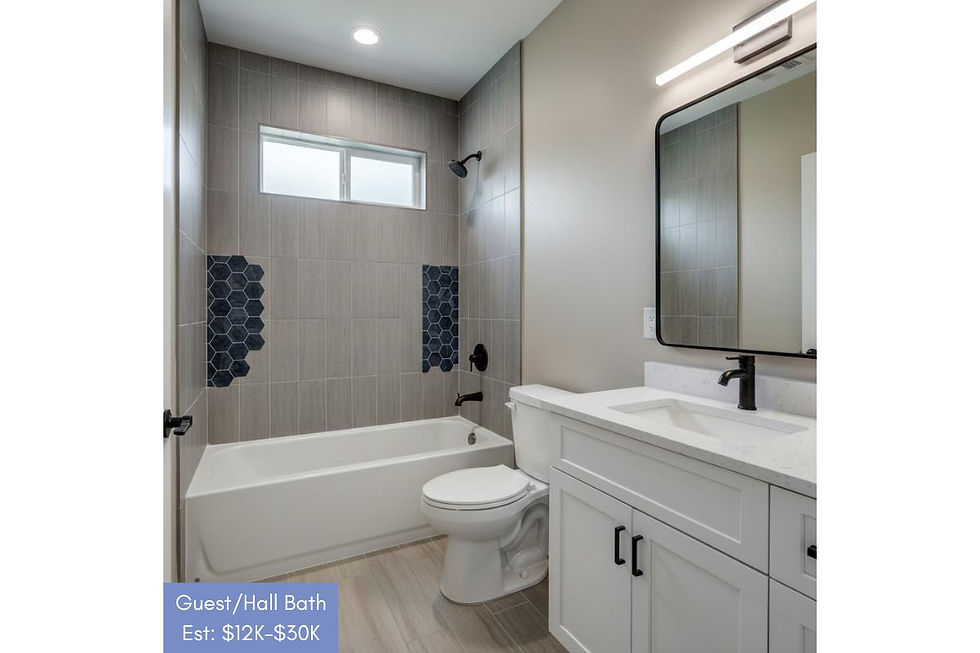
Estimated cost: $12,000 - $30,000
Usually includes a tub or shower plus vanity and toilet.
Tile choices tend to have the biggest impact here—especially in shower surrounds.
Primary Bathroom

Estimated cost: $25,000 - $60,000+
Often the most expensive because it’s larger and includes more features.
Double vanities, larger showers, layered lighting, and upgraded storage all add complexity and cost.
What Makes Remodel Costs Increase
These are the true budget accelerators:
Moving plumbing or changing layout
Heavy tile work (patterns, niches, full-height walls)
Electrical upgrades (new circuits, layered lighting)
Water damage surprises (subfloors, framing)
Permit and code requirements
Rush timelines or special-order finishes

Overall, changing the layout—especially moving plumbing—is the single fastest way to add cost. Tile-heavy designs with patterns, niches, or full-height walls increase both material and labor. Electrical upgrades add up when new circuits or lighting zones are required.
Older homes may reveal water damage once demolition begins, which can lead to necessary but unexpected repairs. Permits and code requirements also vary by region and can influence timelines and pricing.
How to Budget for a Bathroom Remodel Like a Designer
A smart bathroom budget means being realistic and practicing restraint.
It includes:
Finish allowances: tile, vanity, plumbing fixtures
Labor buffer: tile and waterproofing are rarely cheap
Contingency fund: plan for 10–20% extra
One “hero” moment: splurge in one place, simplify elsewhere
Use this as a guide:
Start by setting finish allowances early. Tile, vanities, and plumbing fixtures should be chosen with budget ranges in mind, not guesswork. Plan for a contingency fund of 10–20%, especially if you’re working in an older home.
Prioritize upgrades with high visual impact. Lighting, vanity selection, and shower design tend to affect how a bathroom feels more than trend-driven extras.
If you want to splurge, choose one “hero” moment and keep the rest simple. That’s how designers create elevated spaces without runaway budgets.
Designer tip: Lighting is one of the highest-impact upgrades and often costs less than custom finishes.
Is a Bathroom Remodel Worth It in 2026?
For most homeowners, mid-range bathroom remodels offer the best balance of cost, durability, and long-term appeal. Over-customization can limit resale flexibility, while thoughtful updates improve everyday quality of life.
A well-designed bathroom doesn’t just photograph well—it functions better, lasts longer, and supports how you actually live.
What to remember:
Mid-range remodels deliver the broadest appeal
Over-customization can reduce resale flexibility
A well-designed bathroom improves daily quality of life, not just home value
Frequently Asked Questions
How much does a bathroom remodel cost in 2026
Most homeowners spend between $15,000 and $30,000 for a full mid-range remodel.
What’s the most expensive part of a bathroom remodel?
Labor, especially plumbing, electrical, and tile installation.
Does keeping the layout lower the cost?
Yes. This is the single biggest cost-saving decision.
How long does a bathroom remodel take?
Most full remodels take 4–8 weeks once construction starts.

