


Best Bathroom Vanity Sizes for Small Bathrooms According to a Designer (2026 Guide)

The vanity is the largest piece of furniture in your bathroom, which means choosing the wrong size can throw off the entire room.
In a small bathroom, even a few inches can be the difference between a space that feels intentional and one that feels cramped. Before you order anything, make sure the vanity works with your room size, clearance, plumbing, and daily routine, not just the style you like online.
Below are the bathroom vanity sizes I recommend for small bathrooms, including when each one works and the key NKBA clearance guidelines to know before you order.

Standard Bathroom Vanity Sizes for Small Bathrooms
Most small bathroom vanities come in a few common widths.
Here's your cheat sheet:
Vanity Size | Best For |
24" | Powder rooms or very tight half-baths |
30" | Small bathrooms under 5' × 8'; compact full baths |
36" | Standard small bathroom size; best balance of storage and footprint |
42" | Larger small bathrooms, around 5' × 9' or bigger |
48" | Small-to-medium bathrooms where you want more counter space without moving to a double vanity |
Standard depth
Typically 21", though 18–20" depths are common for small bathrooms to gain back floor space without sacrificing function.
Most vanities fall between 20–24" deep, with double sink models on the larger end. Standard height runs 32–34" for traditional, 34–36" for "comfort height."
NKBA Clearance Requirements You Need to Know
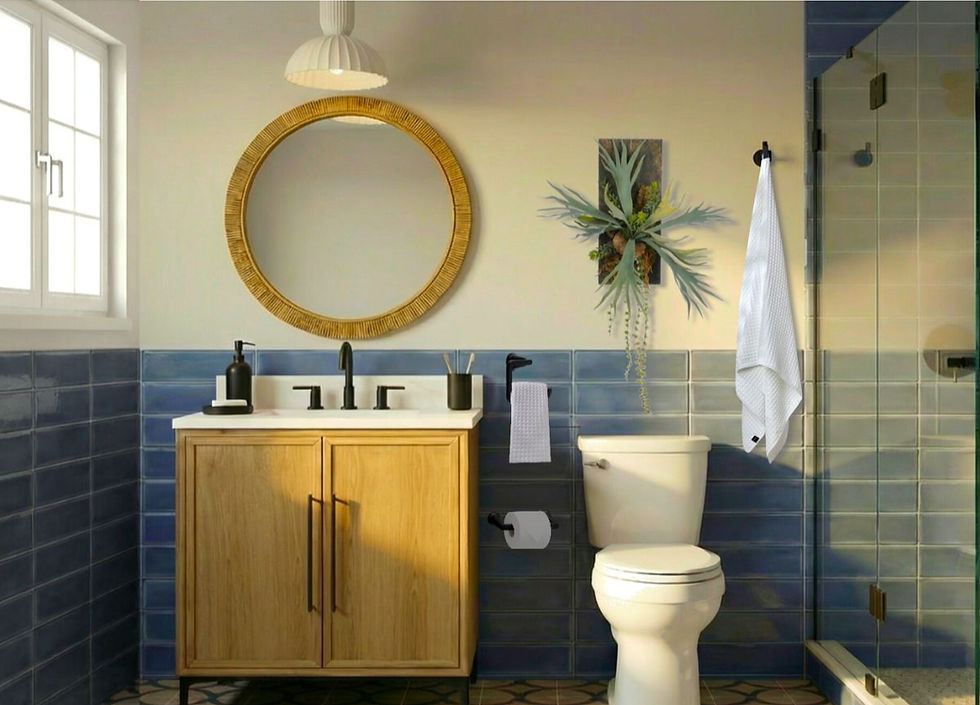
Before you pick a vanity, here are the clearance rules you should know. The NKBA Bathroom Planning Guidelines are the industry-standard reference designers use to ensure bathrooms function properly and meet code.
For vanities, here's what matters:
Front clearance
NKBA recommended: 30" of clear floor space in front of the vanity
Code minimum (IRC): 21" of clear floor space
Anything less than 21" feels cramped daily; may not meet your local building code.
Lavatory centerline to sidewall
NKBA recommended: 20" from the centerline of the lavatory to the sidewall
Code minimum: 15"
Double lavatory spacing
NKBA recommended: 36" between the centerlines of two lavatories
Code minimum: 30"
Vanity height
NKBA acceptable range: 32"–43" depending on user height
Wall-mounted lavatories and console-style vanities offer the most flexibility here.
The reason these specs matter: a vanity that meets code minimum (21" front clearance) may technically pass inspection but feel tight in everyday use. A vanity that meets NKBA's recommended 30" clearance feels normal.
How to Choose the Right Vanity Size

Before you fall in love with a specific vanity, measure these four things first:
1.) Wall width
Measure the wall where the vanity will go, edge to edge. Per NKBA, the lavatory centerline needs at least 15" from any sidewall (20" recommended).
For a centered sink, make sure the sink centerline has enough clearance from nearby walls or tall fixtures. A 30" vanity may technically fit, but the surrounding clearance determines whether it actually feels comfortable.
*This isn't a hard rule on every vanity style, but it's the safe baseline.
2.) Front clearance
You need at least 21" of clear floor space in front of the vanity (30" recommended).
If the door swings into the bathroom, the vanity can't block it.
(For more on bathroom doors and clearance, the International Residential Code requires entry doors not to interfere with fixture use.)
3.) Plumbing rough-in placement
Existing drain and supply lines dictate where the sink can go.
Moving plumbing is possible but expensive ($500–$2,000+).
4.) Door swing arc
Map the arc of every door that swings into or near the bathroom.
Medicine cabinet doors, pocket doors, and the main door can all conflict with vanity placement.
Single Sink vs. Double Sink in Small Bathrooms
If your vanity wall is between 48-60", a single sink with extended counter space looks more refined than a tight double vanity.
Designer rule: don’t squeeze a double sink into anything under 60". If your vanity wall is 48–60", a single sink with extended counter space usually looks more refined and functions better than a tight double vanity.
Floating vs. Freestanding Vanities in Small Bathrooms

In small bathrooms, floating (wall-mounted) vanities almost always look larger than freestanding. Visible floor space is what creates the perception of room; floating vanities expose that floor.
Freestanding vanities with legs (rather than solid base cabinets) are a middle option. They'll show some floor while still offering more storage than a fully floating piece. Pottery Barn and Rejuvenation both have leg-style vanities that work well for this.
Designer rule: in any small bathroom, prioritize visible floor over storage volume. You can always add wall-mounted shelves or a tall storage cabinet later. For more on small-bathroom design moves, see our post on how to make a small bathroom feel bigger.
Where to Save and Where to Spend
Save on:
The vanity cabinet itself. A budget-friendly vanity can look custom with the right hardware, faucet, mirror, and lighting.
Spend on:
Hardware, because it changes the whole look
Faucet, because it’s a daily-use item and cheap finishes age quickly.
Kohler, Brizo, and Newport Brass all carry styles that age well.
Countertop, because quartz will usually look more elevated than laminate.
Mirror or sconces, because they set the room’s tone immediately.
For more on smart material trade-offs, see our bathroom materials guide: where to spend versus save
Frequently Asked Questions
What's the smallest vanity size for a bathroom?
24" is the smallest standard pre-fabricated bathroom vanity size. For very tight powder rooms, custom 20–22" vanities are also available.
What size vanity fits in a 5x8 bathroom?
A 30–36" single vanity fits comfortably in a 5x8 bathroom. Avoid double sinks at this size; the room is too narrow. Beachside Bliss (36" or 42") is specifically designed for this size space.
How much room do I need in front of a vanity?
NKBA recommends 30" of clearance; 21" is the code minimum. Less than 21" feels cramped daily and may not pass inspection in some jurisdictions.
What's the standard bathroom vanity height?
Standard is 32"–34" tall. "Comfort height" vanities are 34"- 36" > closer to kitchen counter height. NKBA's acceptable range is 32"- 43" depending on your height. Tall household members usually prefer comfort height; shorter users sometimes prefer standard.
Can I have a double vanity in a small bathroom?
Only if your vanity wall is 60"+ wide. Below 60", a single sink with extended counter space functions better and looks more designed than a tight double. NKBA's minimum spacing between sink centerlines is 36" (30" code minimum), but the visual reality is that doubles need 60"+ of total width to read properly.
What depth should a small bathroom vanity be?
Standard is 21". For tight small bathrooms, 18–20" deep vanities give back valuable floor space without sacrificing usable counter area. Avoid going below 18" > under-counter storage gets impractical.
Renovating your small bathroom?
Browse design plans built specifically for small and compact bathrooms. Every tile, fixture, finish, and vanity size has already been coordinated into a complete designer-approved look.
Every plan is delivered as an instant-access digital PDF and includes:
✓ Full bathroom renders so you can clearly understand the design direction before purchasing
✓ Complete material palette: tile, vanity, plumbing fixtures, lighting, mirror, paint, and finishes, all selected and shoppable
✓ Direct sourcing links and product details for every item
✓ A 20-minute design review call with Ellyn after purchase
✓ Designer-curated by Ellyn Murphy, NYC interior designer featured on HGTV & DIY Network
✓ Out-of-stock support — if a product becomes unavailable, you can request a comparable designer-approved alternative


